
Honey from our garden
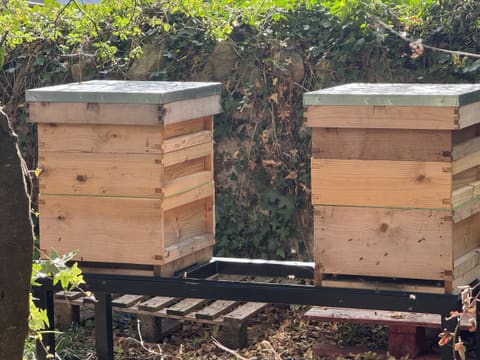
Bassitt's Bee Juice comes from our own hives, in our own garden in Newton Abbot. We aren't a honey farm. We keep a handful of colonies in National hives and look after them through the year.
Everything in the jar is honey. We spin it out of the frames, strain it through a sieve to catch the wax, let it settle and pot it. Nothing is added and nothing is taken away.
The 2026 season
This year was busy. One of our original colonies threw three swarms before it failed. The first of those swarms, the prime swarm, became the star of the season. It made most of the roughly 68 kg we took off across the hives. The changeable weather seemed to suit the flowers, and the flow kept going.
We're aiming for about three strong colonies going into winter, rather than more hives. Fewer, healthier colonies make better honey and happier bees.
On the label
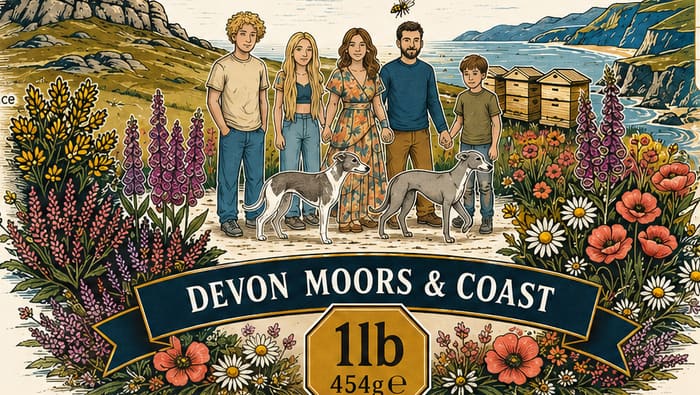
The label shows the whole family, our two whippets, and the Devon we love: the tors, the coast, the heather and the foxgloves.
Where the bees go
A honeybee colony forages over a couple of miles around the hive. For ours, that means the gardens of Wolborough, the woods and lake at Decoy, the hedges and fields to the south, and the lime trees and parks of the town. You can explore it yourself in Hive Mind, our interactive map of the bees' world. Closer to home they work the flowers in our own garden: poppies, cornflowers, cranesbill and a wall of Mexican fleabane. They're in the forage calendar.
Get in touch
Email james@bassitt.co.uk. If you've seen a swarm, please let us know.